It starts on the walk to the car. By the time you’ve climbed a flight of stairs, it’s worse. Halfway through the afternoon, you’re discreetly tugging at your leg under the desk, hoping nobody notices. Underwear ride-up is one of those tiny daily frustrations that almost everyone has experienced and almost nobody talks about.
The good news is that it isn’t inevitable. Ride-up happens for specific, fixable reasons: the wrong length, the wrong size, the wrong fabric, or a waistband that can’t hold its position. Once you understand those reasons, choosing underwear that stays put becomes a lot easier.
This guide walks through why underwear rides up, how to measure yourself properly, what to look for in leg length, fabric and waistband, and how to match your underwear to your day. Along the way, we’ll look at how brands built around active lifestyles, such as Ethika with its long Staple boxer brief, have tackled the problem, so you know what features to look for wherever you shop.
Why underwear rides up in the first place
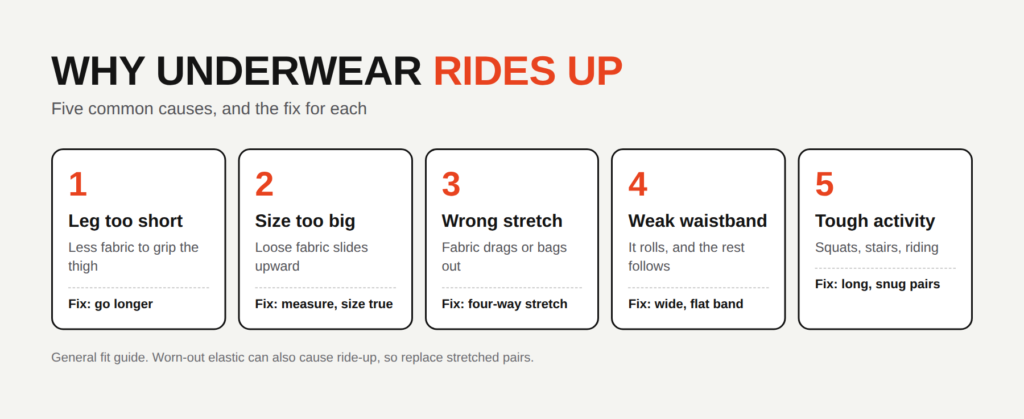
Ride-up isn’t random. When the legs of your underwear creep toward your hips, one or more of these five things is usually to blame.
1. The leg is too short
Short legs have less fabric to grip your thigh, so every step pulls them upward. The higher the leg sits, the more the movement of walking and sitting works it toward the crease of your hip. This is the single biggest cause of ride-up in boxer briefs.
2. The size is too big
Underwear that’s too loose can’t grip. A leg opening with a gap around your thigh slides up easily, and a waistband that’s too large has nothing to anchor it. Many people size up “for comfort” and end up with more ride-up, not less.
3. The fabric has the wrong stretch
Fabric with too little stretch fights against your movement and gets dragged along with it. Fabric that’s stretched out, either because it’s old or because it lost its recovery in a hot dryer, sags and bunches. You want fabric that stretches as you move and then springs back.
4. The waistband can’t hold its place
A narrow or weak waistband rolls and folds over. When the waistband moves, the whole garment shifts, and the legs follow. A wider, flatter waistband spreads pressure and is much less likely to roll.
5. Your activity is working against you
Some movements are simply harder on underwear: cycling, squatting, climbing stairs, long drives and anything that involves a lot of hip flexion. Underwear that’s fine for a desk day can fail completely on a day at the skatepark or in the gym.
The fixes follow directly from the causes: a longer leg, a snug and correct size, fabric with good stretch and recovery, and a waistband that stays flat. Let’s take each in turn.
Start with your measurements
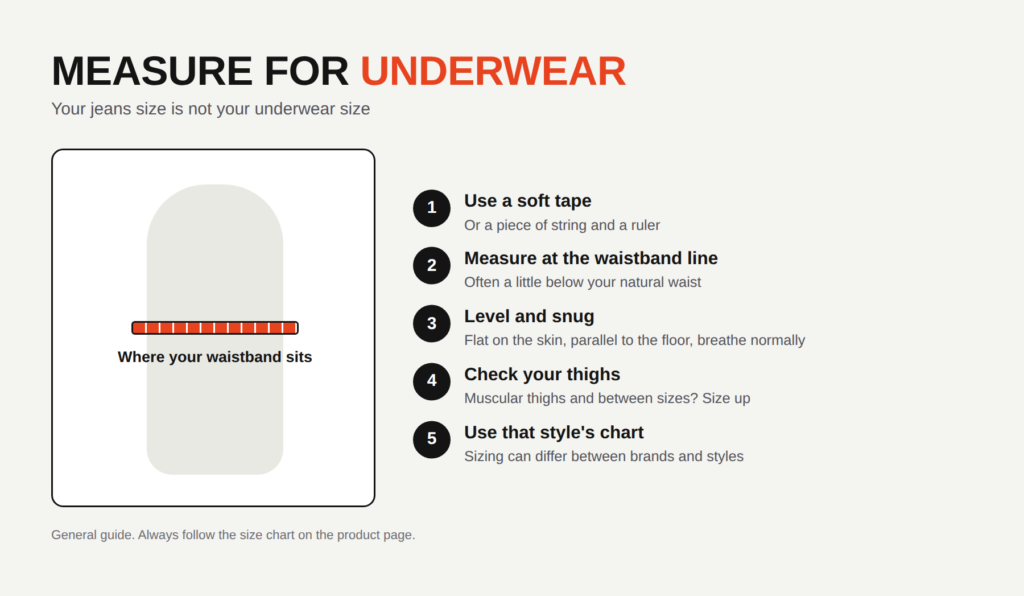
Most people buy underwear based on their pant size, and that’s where a lot of fit problems begin. Jeans sizes vary wildly between brands, and many are labeled smaller than their actual measurement. Underwear sizing is usually based on your true waist measurement, so it’s worth taking a minute to measure.
How to measure your waist for underwear
- Use a soft tape measure. A tailor’s tape works best. If you don’t have one, a piece of string and a ruler will do.
- Find where your waistband sits. Measure around your body at the height where your underwear waistband normally rests, which is often a little below your natural waist.
- Keep it level and snug. The tape should be flat against your skin, parallel to the floor, and snug but not tight.
- Breathe normally. Don’t suck in. You want a measurement you’ll be comfortable in all day.
- Compare with the brand’s size chart. Every brand sizes slightly differently, and even different styles from the same brand can vary. Always check the chart on the product page.
Don’t forget your thighs
Waist size gets all the attention, but for boxer briefs, thigh size matters just as much. If you have muscular thighs from cycling, running, skating or lifting, a size that fits your waist may feel tight around the legs. If you’re between sizes and have bigger thighs, sizing up is usually the better choice. If you have slim legs and you’re between sizes, the smaller size will grip better and ride up less.
Boxers, boxer briefs or briefs?
Before getting into leg lengths, it helps to step back and compare the three main styles. Each solves a different problem.
| Style | Pros | Cons | Best for |
|---|---|---|---|
| Boxers | Loose and airy; very cool in hot weather | No support; fabric bunches under slim pants | Sleeping, lounging, loose trousers |
| Briefs | Supportive; no fabric on the legs; cool | Leg openings can shift; no chafing protection | Warm weather, people who like a minimal feel |
| Boxer briefs | Supportive with leg coverage; work under any clothes | Can ride up if the leg is short or the fit is loose | Everyday wear, activity, slim-fit clothing |
Most people who complain about ride-up are wearing boxer briefs, which is why the rest of this guide focuses on them. The good news is that boxer briefs are also the most fixable style, because leg length and fit make such a big difference.
Leg length: the most important choice
If ride-up is your main problem, leg length is where to start. In general, the longer the leg, the less it rides up, because there’s more fabric gripping your thigh and the hem sits further from the hip crease.
Here’s how the common lengths compare:
- Briefs and trunks: very short or no leg. No ride-up in the traditional sense, but the leg openings can still shift, and they offer no protection against thigh chafing.
- Short and mid-length boxer briefs: a moderate leg. A good balance of coverage and coolness, but more prone to ride-up during activity.
- Long boxer briefs: a long leg that reaches well down the thigh. The best option for ride-up control and chafing protection, especially if you’re active.
This is the logic behind Ethika’s signature Staple, a boxer brief introduced in 2005 with a longer leg and a close fit through the thigh (Wikipedia). Independent reviewers rate its ride-up control as one of its strongest points (Underwearank). Ethika also makes a shorter Mid length for people who want a little less fabric. Whichever brand you choose, the principle is the same: if ride-up bothers you, go longer.
The trade-off: warmth and visibility
Longer legs aren’t perfect for every situation. More fabric means more warmth, which matters in hot weather. And a long leg can show under very short shorts. Many people keep a mix: long boxer briefs for active days and cooler weather, and shorter styles for summer and lounging.
Fabric: stretch, recovery and breathability
The right fabric moves with you, springs back into shape, and keeps you comfortable. Here’s what to know about the most common options.
Cotton
Soft, breathable and familiar. Pure cotton has little stretch, though, and it can bag out over a long day. Most modern boxer briefs blend cotton with elastane (also called spandex or Lycra) for stretch and shape.
Polyester and spandex blends
Smooth, stretchy and good at holding their shape. These blends tend to dry quickly and hold bright prints well, which is why they’re common in performance underwear and in print-heavy brands. Ethika, for example, uses polyester-spandex stretch knits in much of its range. The trade-off is warmth: dense stretch fabrics can run warm, and Underwearank rated breathability as Ethika’s weakest category for that reason (Underwearank).
Modal and other soft fibers
Modal is a soft, smooth fiber made from wood pulp. It feels silky, drapes well and is often blended with elastane for stretch. It’s a lovely choice for lounging and for sensitive skin, though it can be less durable than tougher blends.
Merino wool
Merino is popular for travel and outdoor activities because it handles temperature well and resists odor. It’s usually more expensive and needs gentler care.
What “four-way stretch” means
Four-way stretch fabric stretches both lengthwise and crosswise. That matters for underwear because your body moves in every direction: bending, twisting, sitting and climbing. Fabric that only stretches one way can pull and ride up when you move against its grain. Four-way stretch moves with you, which is why it’s a common feature in underwear built for active days.
The waistband matters more than you think
A waistband has one job: stay where you put it. When it rolls, folds or digs in, the rest of the garment shifts with it. When you’re shopping, look for:
- Width. Wider waistbands spread pressure across a larger area, so they’re less likely to roll or dig in.
- Flatness. A waistband that lies flat against your skin is more comfortable and less visible under clothes.
- Recovery. The elastic should spring back when you stretch it. A waistband that stays stretched after you pull it is already wearing out.
- Comfort against the skin. Some waistbands are covered in soft fabric; others have exposed elastic. If you’re sensitive, a covered band can be more comfortable.
Ethika’s Staple uses a wide signature waistband that’s designed to stay flat during the day, which is a good example of the kind of feature to look for if rolling waistbands drive you mad.
Fit for different body shapes
Size charts are based on averages, and real bodies aren’t average. A few adjustments help depending on your build.
Athletic or muscular thighs
If your thighs are large relative to your waist, standard sizes can feel tight around the legs. Size up if you’re between sizes, look for fabrics with plenty of stretch, and favor styles described as having a roomier leg. A long leg still helps, as long as it isn’t squeezing.
Slim build
If your legs are slim relative to your waist, leg openings may gap, which leads straight to ride-up. Stick to your true size or the smaller of two sizes, and look for a close-fitting leg.
Larger waist or belly
Waistbands can roll down under a belly, which pulls the whole garment out of place. A wider waistband helps, and some people find a slightly higher rise sits more comfortably. Measure where you actually wear the waistband, not where you think it should sit.
Long torso or long legs
If you’re tall, a short boxer brief can sit higher on the thigh than intended. A longer leg style will usually sit where a mid-length leg would on someone shorter.
A 30-second fit test
When you try a new pair, run through this quick check before you commit to buying more:
- Do three squats. The legs should stay roughly where they started.
- Climb a few stairs or do some high knees. Check for creeping at the hem.
- Sit down for a minute. The waistband shouldn’t dig in or fold over.
- Check the leg openings. There should be no gap, but no deep marks either.
- Look in the mirror with pants on. There should be no bunching or visible ridges through your trousers.
If a pair passes all five, you’ve found your size and style. Wear it for a full day before buying a whole drawer’s worth.
Matching your underwear to your day
No single pair is perfect for everything. Thinking about what you’re doing that day helps you reach for the right pair.
| Your day | What to look for | Why |
|---|---|---|
| Desk and commuting | Mid or long leg, soft fabric | Comfort while sitting; less fidgeting on the train or in the car |
| Gym and training | Long leg, four-way stretch, quick-drying | Stays put through squats and lunges; handles sweat |
| Skating, riding, cycling | Long leg, snug fit | Protects against chafing and ride-up during hip-heavy movement |
| Hot weather | Shorter leg, lighter or more breathable fabric | Less fabric and better airflow |
| Long travel days | Long leg, soft stretch fabric | Comfortable for hours of sitting without riding up |
| Physical jobs | Long leg, durable stretch blend | Holds up to a full day of standing, lifting and walking |
Common fit problems and quick fixes
- “The legs creep up when I walk.” Go longer and check you’re not wearing a size too big.
- “The waistband rolls down.” Re-measure your waist. A band that’s too tight gets pushed down, and one that’s too loose can’t grip. A wider waistband also helps.
- “The legs dig into my thighs.” Size up if you’re between sizes, or try a fabric with more stretch.
- “They bunch up under my jeans.” Look for a slimmer, closer fit and a fabric that holds its shape. Loose fabric is what bunches.
- “They’re too hot.” Try a shorter leg or a more breathable fabric for warm days, and keep long, dense pairs for cooler weather and activity.
- “They felt great at first, then got baggy.” The fabric has probably lost its recovery. Hot washes and high-heat drying are the usual culprits. See the care section below.
Pairing underwear with your clothes
The right underwear also depends on what you wear over it.
- Slim jeans and chinos: close-fitting boxer briefs with a mid or long leg. Loose underwear bunches under slim cuts.
- Suits and dress trousers: smooth, solid-colored boxer briefs in a fabric that doesn’t show lines. Avoid bright prints under light-colored fabric, since they can show through.
- Athletic shorts: a long-leg boxer brief adds coverage and prevents chafing, particularly under loose shorts without a liner.
- Short shorts: a shorter leg so the underwear doesn’t peek out at the hem.
- Joggers and sweatpants: almost anything works. This is where a bold print or a visible waistband can be part of the look.
Five underwear myths
“Looser is more comfortable”
Up to a point. Underwear that’s too loose rides up, bunches and shifts, which is less comfortable over a full day.
“All boxer briefs are the same”
Leg length, fabric, waistband width and cut vary enormously between brands and styles. That’s why one brand can ride up constantly while another stays put.
“Your underwear size is your jeans size”
Often it isn’t. Jeans sizes vary between brands, so measure your waist and check the underwear size chart.
“Expensive underwear is just marketing”
Sometimes. But features like four-way stretch, a wider waistband, longer legs and better fabric recovery do cost more to make, and they’re often what solves ride-up. Judge a pair by its features and fit, not its price.
“Ride-up means you need a new brand”
Not necessarily. It may mean you need a different size, a longer leg or simply a fresh pair, because worn-out elastic loses its grip.
Make your underwear last
Even the best-fitting pair will start to ride up once its fabric and elastic wear out. Good care keeps your underwear fitting the way it did on day one.
- Wash cold. Heat breaks down elastane over time.
- Skip the high-heat dryer. This is the biggest single cause of stretched-out waistbands. Air dry or use a low setting.
- Go easy on fabric softener. It can coat stretch fabrics and reduce their stretch and moisture-wicking performance.
- Turn printed pairs inside out. This protects prints from rubbing against other clothes.
- Use a mesh bag. It reduces friction and stops pairs tangling with zips and hooks.
- Rotate. A larger collection means each pair is washed less often and lasts longer.
When to replace your underwear
There’s no fixed rule, but a few signs mean it’s time: a waistband that stays stretched when you pull it, fabric that’s gone thin or see-through, legs that won’t stay down no matter what, and holes or loose seams. If your favorite pairs are riding up more than they used to, worn-out elastic is often the reason, not your body or the brand.
How many pairs should you own?
A bigger rotation isn’t just convenient. It also helps every pair last longer and keep its fit. As a rough guide:
- At least ten pairs covers more than a week, so you’re not doing laundry in a panic.
- Twelve to fourteen pairs gives you two weeks of rotation plus spares.
- Add a few activity pairs if you train often, so your everyday pairs don’t take the extra wear.
Buying underwear online without the guesswork
Underwear is one of the trickiest things to buy online, partly because returns are often limited. Many brands treat underwear as final sale for hygiene reasons. A few habits reduce the risk:
- Measure first. Take your waist measurement before you browse.
- Read the size chart for that exact style. Don’t assume your size in one style is the same in another.
- Check the fabric composition. More elastane usually means more stretch and grip.
- Look at the leg length. If the product page lists an inseam, compare it with a pair you already like.
- Read reviews about fit. Look for comments about whether a style runs small, large or true to size.
- Check the return terms before you buy. Know whether you can exchange a size if needed.
- Start small. Buy one or two pairs, wear them for a full day, then buy more.
Underwear for active lifestyles
It’s no coincidence that some of the most ride-up-resistant underwear comes from brands rooted in sport. Ethika grew up in Southern California’s skateboarding and motocross scene, where riders spend hours in deep squats, on bikes and on boards (Wikipedia). Underwear that rode up or chafed simply wasn’t an option, and that shaped the long-legged Staple design.
If you’re active, a few extra tips:
- Keep dedicated workout pairs. Sweat and frequent washing wear underwear faster, so rotate a few pairs just for training.
- Change after training. Sitting in damp underwear increases the risk of chafing and irritation.
- Choose long legs for leg-heavy days. Squats, lunges, cycling and running all benefit from a longer leg.
- For long road rides, use padded cycling shorts. Regular underwear isn’t designed for hours in the saddle.
A note on comfort and skin health
Underwear that fits well isn’t just about convenience. Constant rubbing from a leg that rides up or a seam that shifts can lead to chafing, especially in hot weather or during exercise. Fabrics that trap heat and moisture can also make irritation more likely. Choosing the right length, fit and fabric for the conditions goes a long way. If you have persistent skin irritation or a rash that doesn’t settle, it’s worth seeing a doctor or pharmacist.
Building a smarter underwear drawer
Rather than one style for everything, think of your drawer as a small toolkit:
- Everyday core (six to eight pairs): mid or long boxer briefs in solid colors, in the size and fabric that passed your fit test.
- Activity pairs (three or four): long-leg, four-way stretch pairs reserved for the gym, riding or sport.
- Warm-weather pairs (two or three): shorter legs or more breathable fabrics for hot days.
- Dress pairs (two): smooth, solid pairs that disappear under suits and light trousers.
- A few fun ones: prints you enjoy wearing. Brands like Ethika are known for bold graphics that make underwear a little more personal.
When something wears out, replace it within its category. You’ll always have the right pair for the day.
A seasonal guide
- Summer: shorter legs and lighter, more breathable fabrics. Change after sweaty activities to avoid chafing.
- Fall and spring: mid or long legs in your favorite everyday fabric. This is when most people can wear long boxer briefs comfortably all day.
- Winter: long legs come into their own, adding a little warmth under jeans and trousers. Merino is a good option for cold outdoor days.
A quick glossary
- Inseam: the length of the leg, measured from the crotch seam to the hem.
- Rise: how high the waistband sits, from the crotch to the top of the waistband.
- Elastane, spandex, Lycra: different names for the stretchy fiber blended into fabrics to give stretch and shape.
- Recovery: a fabric’s ability to spring back after stretching. Good recovery keeps underwear from bagging out.
- Four-way stretch: fabric that stretches in both directions, lengthwise and crosswise.
- Pouch: the shaped front panel in men’s underwear, designed for support.
- Flatlock seams: flat, low-profile seams that reduce rubbing against the skin.
Frequently asked questions
Why do my boxer briefs ride up?
Usually because the leg is too short, the size is too big, the fabric lacks stretch or recovery, or the waistband rolls. A longer leg in a snug, correct size is the most effective fix.
Should boxer briefs be tight?
They should be snug, not tight. They should hold their position and grip your thigh without leaving deep marks or restricting movement.
Does sizing up stop ride-up?
Usually not. Sizing up often makes ride-up worse, because looser fabric slides more easily. Size up only if the legs or waistband feel genuinely tight.
What leg length is best to prevent ride-up?
A long boxer brief that reaches well down the thigh, such as Ethika’s Staple, generally offers the best ride-up control.
What fabric is best for active days?
Fabrics with four-way stretch and good recovery, such as polyester or nylon blended with elastane, hold their position well and dry quickly. If you run hot, look for lighter or more breathable versions.
How do I keep my underwear from stretching out?
Wash cold, avoid high-heat drying, skip fabric softener and rotate your pairs. Heat is the main enemy of elastic.
How often should I replace my underwear?
When the waistband stays stretched, the fabric gets thin, the legs won’t stay down, or seams start to fail. With good care, quality pairs last much longer.
Are long boxer briefs hotter than short ones?
Usually a little, because there’s more fabric covering your legs. In hot weather, many people switch to a shorter leg or a lighter, more breathable fabric, and save long legs for activity and cooler days.
Can the wrong underwear cause chafing?
Yes. Legs that ride up, loose fabric that bunches, and rough seams can all rub against the inner thigh, especially in heat or during exercise. A long, snug leg and smooth seams help prevent it.
Is printed underwear less comfortable than solid colors?
Not in itself. Comfort depends on the fabric, fit and construction, not the print. Printed stretch fabrics can feel just as smooth as solids. The main practical difference is that bright prints can show through light-colored clothes.
Do I need different underwear for the gym?
It helps. A long-leg, four-way stretch pair that handles sweat will stay put through squats and runs far better than a loose cotton pair, and keeping separate workout pairs makes your everyday pairs last longer.
The bottom line
Ride-up isn’t something you have to live with. It comes down to a few factors you can control: a longer leg, the right size for both your waist and your thighs, fabric that stretches and recovers, and a waistband that stays flat. Get those right, and your underwear will stay where it belongs from morning to night.
Measure yourself, pay attention to leg length, look for four-way stretch and a wide waistband, and treat your pairs kindly in the wash. Whether you choose a long-leg design like Ethika’s Staple or another brand entirely, those principles will help you find underwear you never have to think about.