Disclosure: this post may contain affiliate links. If you buy through them, we may earn a commission at no extra cost to you. Product details and brewing instructions were checked on the Harney & Sons website in October 2026.
Have you ever bought a beautiful tin of tea, brewed a cup, and found it bitter, weak or just disappointing? You’re not alone. Most of the time, the problem isn’t the tea. It’s the water, the temperature or the timing. The good news is that brewing tea well is easy once you know a few simple rules, and those rules work whether you’re making a mug of English Breakfast before work or a delicate jasmine green tea on a Sunday afternoon.
In this guide, we’ll walk through how to brew every major type of tea, from black and green to white, oolong, herbal and matcha. We’ll cover water, temperature, steeping time and how much tea to use, along with iced tea, cold brew and tea with milk. We’ll also fix the most common brewing mistakes and suggest a few teas from Harney & Sons, the family-owned tea company in Millerton, New York, to practice with. Every Harney & Sons product page lists brewing instructions, so we’ll use those as our guide throughout.
First, what is tea?
All “true” teas, whether black, green, white or oolong, come from the same plant: Camellia sinensis. The differences come from how the leaves are processed after picking.
- Green tea is heated soon after picking, by steaming or pan-firing, to stop the leaves from oxidizing. That keeps the flavor fresh, grassy or vegetal.
- White tea is the least processed. Young leaves and buds are simply withered and dried, giving a light, delicate cup.
- Oolong tea is partly oxidized, so it sits between green and black. Oolongs can be light and floral or dark and toasty.
- Black tea is fully oxidized, which gives it a darker color and a bolder, maltier flavor.
Then there are herbal teas, sometimes called tisanes, which aren’t made from the tea plant at all. Chamomile, peppermint, rooibos and ginger infusions are made from flowers, leaves, roots and spices, and are naturally caffeine-free.
Why does this matter for brewing? Because the more delicate the leaf, the gentler it needs to be treated. Black teas and herbals can handle boiling water and longer steeps, while greens and whites need cooler water and shorter times.
The four rules of a great cup
Almost every brewing problem comes down to one of four things: water, temperature, time or quantity. Get these right and you’ll make great tea every time.
1. Start with good water
Tea is mostly water, so the water you use matters. Harney & Sons recommends fresh spring or filtered water on every one of its brewing guides. Very hard water, or water with a strong chlorine taste, can make tea taste flat or bitter. Use fresh cold water each time rather than reboiling water that’s been sitting in the kettle, since reboiled water can taste flat.
2. Use the right temperature
This is the rule people most often break. Pouring boiling water over a delicate green tea scorches the leaves and pulls out bitter compounds. Black teas, on the other hand, need very hot water to release their full flavor.
3. Steep for the right time
Steeping too long is the most common cause of bitter tea. Steeping too briefly gives you a thin, weak cup. Use a timer, at least until you get a feel for it.
4. Use the right amount of tea
Harney & Sons recommends about 1 teaspoon (2.5 g) of loose tea per 8 oz cup, 1 teabag per 8 oz cup, or 1 sachet per 12 oz mug. If you want a stronger cup, add more tea rather than steeping longer. Longer steeps add bitterness faster than they add flavor.
The brewing chart
Here’s a quick reference based on the brewing instructions on Harney & Sons’ product pages. Use it as a starting point, then adjust to your taste.
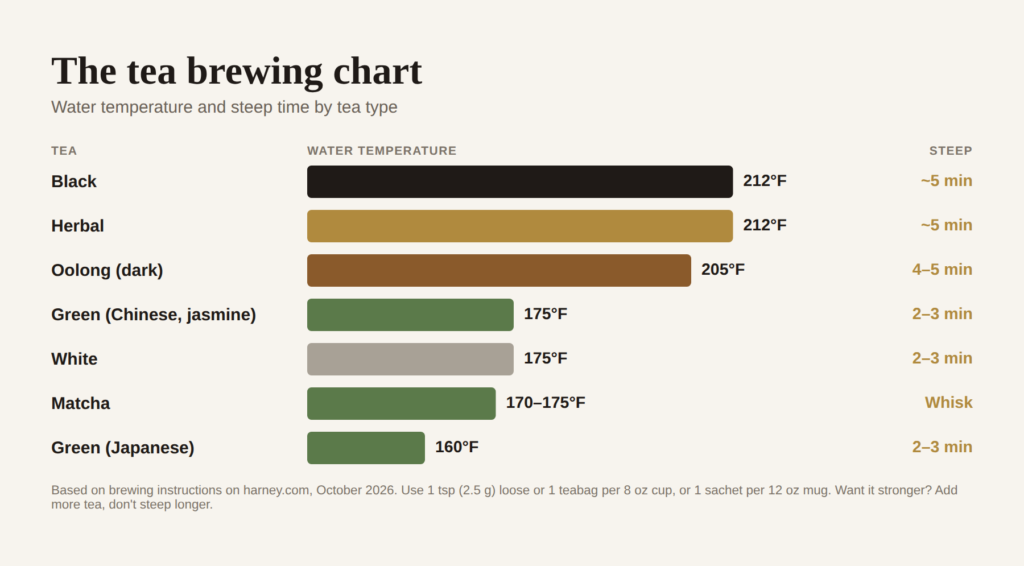
| Tea type | Water temperature | Steep time | Harney & Sons example |
|---|---|---|---|
| Black | 212°F (full boil) | About 5 minutes | English Breakfast, Earl Grey Supreme, Paris |
| Oolong (dark, toasty) | 205°F | 4 to 5 minutes | Formosa Oolong |
| Green (Chinese, jasmine) | About 175°F | 2 to 3 minutes | Dragon Pearl Jasmine |
| Green (Japanese) | About 160°F | 2 to 3 minutes | Japanese Sencha |
| White | About 175°F | 2 to 3 minutes | Chinese Silver Needle, White Peach |
| Herbal | 212°F (full boil) | About 5 minutes | Chamomile, Peppermint |
| Matcha | About 170°F to 175°F | Whisk, don’t steep | Organic Ceremonial Grade Matcha |
How to brew black tea
Black tea is the most forgiving type to brew, which makes it a great place to start.
- Heat fresh, filtered water to a full boil (212°F).
- Warm your cup or teapot with a splash of hot water, then pour it out. This keeps the brewing temperature steady.
- Add your tea: 1 teaspoon of loose leaf or 1 teabag per 8 oz cup, or 1 sachet per 12 oz mug.
- Pour the water over the tea and steep for about 5 minutes. Harney & Sons recommends 5 minutes for teas like English Breakfast, Earl Grey Supreme and Hot Cinnamon Spice, and 4 to 5 minutes for Paris.
- Remove the tea so it doesn’t keep steeping, then add milk, lemon or sweetener if you like.
If you find black tea too strong at 5 minutes, try 3 or 4. If it’s bitter, your tea may be steeping too long or you may be using too much.
Good teas to practice with: Harney & Sons English Breakfast, made from 100% Chinese Keemun, with notes of toast and honey; Earl Grey Supreme, a full-leaf blend with Italian bergamot; and Paris, a fruity black tea with caramel, vanilla and black currant.
Tea with milk
Strong black teas like English Breakfast, Irish Breakfast and Scottish Morn are made to take milk. For the best flavor, brew the tea first, remove the leaves, then add milk to taste. Adding milk to the water before the tea has steeped cools the water and makes it harder for the tea to brew properly. Lighter teas, like green, white and most oolongs, are usually best without milk.
How to brew green tea
Green tea has a reputation for being bitter, but properly brewed green tea is sweet, fresh and smooth. The secret is cooler water and a shorter steep.
- Heat water to about 160°F to 175°F. Japanese green teas like sencha prefer the lower end; Chinese greens and jasmine teas can take a little more heat. Harney & Sons recommends about 160°F for Japanese Sencha and about 175°F for Dragon Pearl Jasmine.
- No thermometer? Bring water to a boil, then let it rest with the lid off for a few minutes, or pour it into a separate cup first to cool slightly.
- Add your tea and steep for 2 to 3 minutes.
- Taste before you add anything. Good green tea rarely needs sugar.
Re-steeping: many loose green teas can be steeped two or three times. Each infusion tastes a little different, and you’ll get more cups from the same leaves.
Good teas to practice with: Japanese Sencha, a classic steamed green from Shizuoka, Japan, with fresh, grassy notes and a hint of citrus; and Dragon Pearl Jasmine, hand-rolled pearls of green and white tea scented with real jasmine blossoms that unfurl as they steep.
How to brew white tea
White tea is delicate and subtle, with notes of honey, melon or flowers. It’s easy to brew, but easy to overwhelm.
- Heat water to about 175°F.
- Use a generous amount of tea. White tea leaves are often fluffy and light, so a teaspoon by volume may weigh less than a teaspoon of black tea.
- Steep for 2 to 3 minutes.
Harney & Sons’ advice for white tea is worth remembering for every type: if you want more flavor, add more tea rather than steeping longer.
Good teas to try: Chinese Silver Needle, made from tender buds; King of Bai Mudan for a fuller white tea; and flavored whites like White Peach or Winter White Earl Grey.
How to brew oolong tea
Oolong is the most varied tea category, ranging from light, floral, green-style oolongs to dark, roasted ones. Brewing depends on the style.
- Dark, roasted oolongs such as Harney & Sons’ Formosa Oolong can take very hot water. Harney recommends 205°F for 4 to 5 minutes. Formosa Oolong is a traditional brown Taiwanese oolong with a toasty flavor, and its stems are included, which is traditional in Taiwan.
- Lighter, greener oolongs generally do better with slightly cooler water, around 185°F to 195°F, and shorter steeps. Check the instructions for your specific tea.
Oolongs are excellent for re-steeping. Many people enjoy three or more infusions from the same leaves, with the flavor changing each time.
How to brew herbal tea
Herbal infusions are the easiest of all. Because they’re made from flowers, herbs, roots and spices rather than tea leaves, they don’t turn bitter the way tea can.
- Bring water to a full boil (212°F).
- Pour it over the herbs and steep for about 5 minutes, or longer for a stronger flavor.
- Cover your cup while it steeps to keep in the aromatic oils, especially with mint and chamomile.
Good teas to try: Harney & Sons Chamomile, made entirely from whole Egyptian chamomile flowers, soft and honeyed with a hint of apple; Peppermint; Organic Ginger Turmeric; and Herbal Hot Cinnamon Spice, a caffeine-free version of the brand’s famous blend.
How to make matcha
Matcha is different from other teas. Instead of steeping leaves and throwing them away, you whisk finely ground green tea powder into water and drink the whole leaf. That gives matcha its vivid green color, creamy texture and rich, savory flavor.
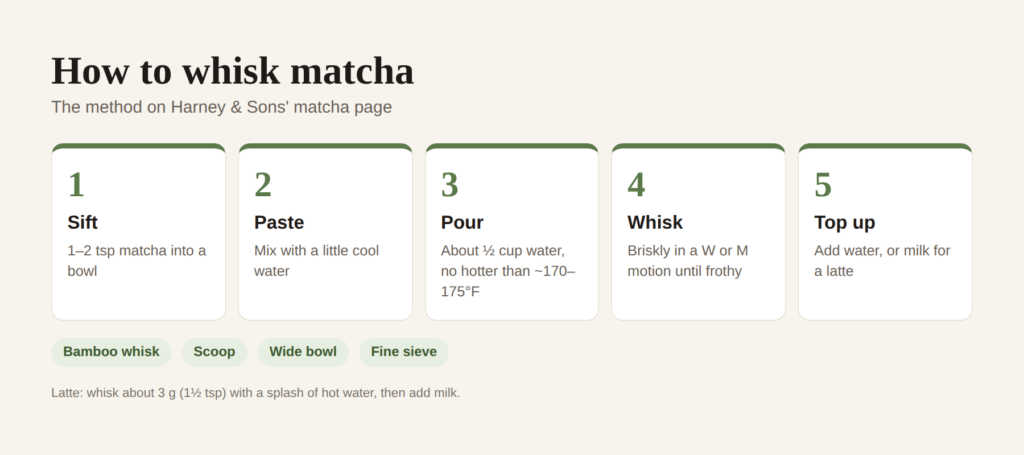
Harney & Sons gives this method on its matcha page:
- Add 1 to 2 teaspoons of matcha to a bowl or cup. Sifting it first helps prevent clumps.
- Add a little cool water and mix into a smooth paste.
- Add about half a cup of warm water, no hotter than about 170°F to 175°F.
- Whisk vigorously in a quick W or M motion, rather than circles, until frothy.
- Add more water to reach your preferred strength.
For a matcha latte, Harney suggests whisking about 3 g (roughly 1½ teaspoons) with a splash of hot water, then adding milk. Steamed oat milk and dairy milk both work well.
What you’ll need: a bamboo whisk (chasen), a scoop and a wide bowl make a big difference. Harney & Sons sells these individually and in matcha sets.
Choosing a matcha: ceremonial grades are meant to be whisked with water and enjoyed plain, while culinary grades are designed for lattes, smoothies and baking. Harney’s range includes options such as Organic Ceremonial Grade Matcha and Culinary Matcha, plus flavored matchas.
How to make iced tea
Homemade iced tea is easy, cheap and far tastier than most bottled versions. There are two main methods.
Method 1: hot brew, double strength
This is the method Harney & Sons recommends on its product pages.
- Brew your tea at double strength, using twice the usual amount of tea for the same amount of water, at the normal temperature and time for that type.
- Pour the hot tea over a tall glass of ice. The melting ice dilutes it to the right strength and chills it instantly.
This method is quick and makes a bright, full-flavored iced tea. For green tea, keep the water at the cooler temperature; Harney recommends 160°F for Japanese Sencha even when making it iced.
Method 2: cold brew
Cold brewing is popular because it produces a very smooth, naturally sweet iced tea with little bitterness. A common approach is to add loose tea or sachets to a pitcher of cold, filtered water, cover it, and leave it in the refrigerator for several hours or overnight, then strain. Experiment with the amount of tea and steeping time to get the strength you like. Keep cold-brewed tea refrigerated and drink it within a day or two for the best flavor.
Best teas for iced tea
- Paris, whose fruity caramel and vanilla notes are delicious over ice.
- Hot Cinnamon Spice, for a surprisingly refreshing spiced iced tea.
- Japanese Sencha or Dragon Pearl Jasmine for a light, floral iced green tea.
- Harney’s Fresh Brew Iced Teas, designed for pitchers, in flavors like Blood Orange and Tropical Mango.
How to brew a pot for guests
Making tea for a group is just as easy as making a single cup, and a teapot keeps everything hot and relaxed.
- Warm the pot by swirling some hot water inside, then pouring it out.
- Measure the tea: about 1 teaspoon of loose tea per 8 oz of water. A standard 32 oz teapot needs about 4 teaspoons. Some people add “one for the pot,” but start with the standard amount and adjust.
- Add water at the right temperature for the tea you’re using, then steep for the recommended time.
- Remove the leaves or strainer when the time is up, so the last cup tastes as good as the first. If your teapot has no removable strainer, pour the tea through a strainer into a second warmed pot.
- Set out milk, lemon, sugar and honey so guests can customize their cups.
For a mixed group, offer one caffeinated black tea, such as Paris or English Breakfast, and one caffeine-free herbal, such as Chamomile or Herbal Hot Cinnamon Spice.
Milk, lemon, honey or sugar?
How you finish your tea is a matter of taste, but a few pairings work especially well:
- Milk suits strong black teas like English Breakfast, Irish Breakfast, Scottish Morn and chai. Avoid adding it to lemon in the same cup, as the acid can curdle it.
- Lemon brightens Earl Grey and lighter black teas, and adds a fresh note to iced tea.
- Honey is lovely with chamomile, ginger and herbal blends. Let the tea cool slightly before adding it if you want to keep its flavor.
- Nothing at all is often best for green, white and high-quality oolong teas, where additions can hide delicate flavors.
Flavored blends such as Paris and Hot Cinnamon Spice already taste sweet from their spices and flavorings, so try them plain before reaching for sugar.
Three easy tea drinks to make at home
London Fog
Brew a strong cup of Earl Grey, using an extra teabag or sachet in about 6 oz of water. Add steamed or frothed milk and a little vanilla or honey. Harney & Sons also makes a blend called Victorian London Fog for its Historic Royal Palaces collection.
Stovetop chai
Simmer a chai blend, such as Harney’s Chai, in equal parts water and milk for a few minutes, sweeten to taste, and strain. Simmering gives a richer, creamier cup than steeping in a mug.
Spiced iced tea
Brew Hot Cinnamon Spice at double strength, pour it over ice, and add a slice of orange. It’s a surprisingly refreshing way to enjoy a winter favorite in summer.
Troubleshooting: why does my tea taste wrong?
If your tea isn’t tasting the way you want, here’s how to fix the most common problems.
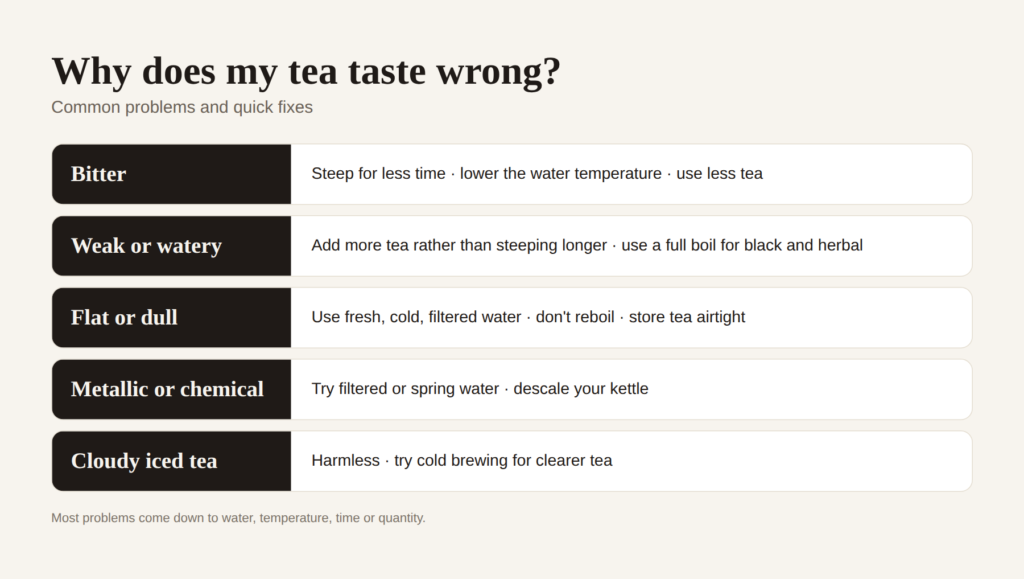
My tea is bitter
- You may be steeping too long. Use a timer and remove the tea when it’s done.
- Your water may be too hot. This is the most common issue with green and white teas.
- You may be using too much tea for the amount of water.
My tea is weak or watery
- Add more tea rather than steeping longer.
- Make sure the water is hot enough, especially for black teas and herbals, which need a full boil.
- Check the size of your mug. A sachet is designed for a 12 oz mug and a teabag for an 8 oz cup; a very large mug needs more tea.
My tea tastes flat or dull
- Use fresh, cold, filtered water, and avoid reboiling.
- Your tea may be old or stored badly. Keep tea in an airtight tin, away from heat, light and moisture.
My tea tastes metallic or chemical
- Your tap water may contain chlorine or minerals. Try filtered or spring water.
- Descale your kettle regularly if you live in a hard-water area.
My iced tea went cloudy
- Cloudiness is common when strong hot tea is chilled quickly. It doesn’t affect safety, and it often tastes fine. Cold brewing usually produces clearer iced tea.
Sachets, teabags or loose leaf: does format affect brewing?
The format you choose changes how you brew, a little.
- Loose leaf gives the leaves the most room to expand and lets you control exactly how much tea you use. You’ll need an infuser, strainer or teapot.
- Silken sachets, Harney & Sons’ signature pyramid-shaped bags, hold whole-leaf tea and give it room to unfurl, so the flavor is close to loose leaf. One sachet is meant for a 12 oz mug.
- Teabags usually hold smaller tea pieces, which brew quickly. One teabag is meant for an 8 oz cup.
- Tea pods for single-serve brewers are the most convenient, though you have less control over temperature and time.
Whatever you use, the same rules apply: right water, right temperature, right time, right amount.
Essential tea equipment
You don’t need much to brew great tea, but a few tools help:
- A kettle with temperature settings. It’s the single best upgrade for anyone who drinks green, white or oolong tea.
- A timer, or just your phone.
- An infuser basket that sits in your mug, for loose tea.
- A teapot with a removable strainer, so you can stop the steeping when the tea is ready.
- A measuring spoon. About 1 teaspoon (2.5 g) per 8 oz cup is the standard.
- A water filter, if your tap water is hard or tastes of chlorine.
- Airtight tins for storing tea.
Harney & Sons’ Finest Tea Starter Kit pairs Hot Cinnamon Spice with an infuser and measuring spoon, a simple way to start with loose tea.
How much caffeine is in tea?
Harney & Sons lists its caffeinated teas, including black, green, white and oolong, at about 40 to 60 mg per cup. That’s usually less than a typical cup of brewed coffee. Matcha tends to contain more caffeine per serving because you consume the whole leaf, and the amount depends on how much powder you use.
A popular belief is that green or white tea always has less caffeine than black tea, but caffeine varies with the specific tea, the amount you use, the water temperature and the steeping time. For a caffeine-free option, choose an herbal infusion such as chamomile or peppermint. Decaf teas still contain a small amount of caffeine.
The FDA notes that, for healthy adults, 400 mg of caffeine a day is not generally associated with negative effects, though sensitivity varies. If you’re pregnant, breastfeeding, managing a health condition or taking medication, ask your doctor how much caffeine is right for you (FDA).
A tea for every time of day
Once you know how to brew each type, it’s easy to build a daily routine around tea:
- Morning: a bold black tea such as English Breakfast, Irish Breakfast or Scottish Morn, with or without milk. Brew at a full boil for about 5 minutes.
- Mid-morning: a green tea such as Japanese Sencha, brewed at about 160°F for 2 to 3 minutes, for a lighter lift.
- Afternoon: a fragrant blend such as Paris or Earl Grey Supreme, perfect with a cookie or a slice of cake.
- Early evening: a decaf version of your favorite, such as Decaf Paris or Decaf Hot Cinnamon Spice.
- Bedtime: a caffeine-free herbal such as Chamomile or Peppermint, steeped for 5 minutes with a lid on the cup.
Everyone’s caffeine sensitivity is different, so if tea later in the day keeps you awake, switch to herbal infusions earlier.
How to store tea so it stays fresh
Tea doesn’t spoil the way food does, but it loses flavor over time. Keep it fresh by protecting it from air, light, heat, moisture and strong odors.
- Use airtight, opaque containers. Harney & Sons’ metal tins are ideal.
- Keep tea in a cool, dark cupboard, away from the stove, dishwasher and sunny windows.
- Skip the fridge, which can add moisture and odors.
- Store strongly flavored teas separately from delicate greens and whites, as aromas can transfer.
- Enjoy green and white teas sooner. Their fresh flavors fade faster than black tea.
A tea flight to train your palate
One of the best ways to learn about tea is to brew several types side by side. Here’s a simple tasting flight using Harney & Sons teas:
- White: Chinese Silver Needle or White Peach. Notice how light and delicate it is.
- Green: Japanese Sencha. Look for grassy, fresh and slightly savory notes.
- Scented green: Dragon Pearl Jasmine. Notice the floral aroma and how the pearls unfurl.
- Oolong: Formosa Oolong. Taste its toasty, roasted character.
- Black: English Breakfast. Notice the body and the toast-and-honey notes.
- Flavored black: Paris or Hot Cinnamon Spice. Taste how flavorings change a black tea.
Brew each at its recommended temperature and time, taste them in order from lightest to boldest, and take notes. You’ll quickly learn which styles you prefer. Harney’s sampler boxes, such as the Harney Heritage Teabag Sampler and the Green Teabag Sampler, are an affordable way to try several teas at once.
Frequently asked questions
Should I use boiling water for all tea?
No. Boiling water is right for black and herbal teas, and for dark oolongs at around 205°F. Green and white teas need cooler water, around 160°F to 175°F, or they can taste bitter.
How long should I steep tea?
About 5 minutes for black and herbal teas, 4 to 5 minutes for dark oolongs, and 2 to 3 minutes for green and white teas. Adjust to your taste.
Can I reuse tea leaves?
Yes, especially loose green teas and oolongs, which often give two or three good infusions. Black teas and teabags usually give their best flavor in the first steep.
Should I squeeze my teabag?
It’s best not to. Squeezing can release extra bitterness. Just lift it out and let it drain.
What’s the best water for tea?
Fresh, cold, filtered or spring water. Harney & Sons recommends it on every brewing guide.
How do I make tea stronger without making it bitter?
Use more tea instead of steeping longer.
Is cold-brewed tea less bitter?
Many people find cold-brewed tea smoother and less bitter, because cold water extracts flavor more gently. It also takes much longer, usually several hours in the refrigerator.
The bottom line
Great tea doesn’t require expensive gadgets or complicated rituals. It comes down to four simple rules: start with good water, use the right temperature, steep for the right time, and use the right amount of tea. Black and herbal teas like boiling water and about five minutes; green and white teas prefer cooler water and two or three minutes; oolongs fall in between; and matcha is whisked, not steeped.
If you’re ready to put these tips into practice, Harney & Sons is a great place to start. Every tea comes with clear brewing instructions, the range covers every type in this guide, and samplers make it easy to experiment. Start with a classic like English Breakfast or Paris, then branch out into green, white and oolong as your confidence grows.